

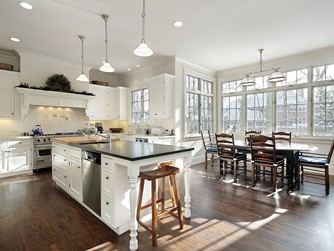
Installing new hardwood floors is an exciting upgrade that enhances the comfort, appearance, and resale value of your home. However, rushing the installation process without allowing the raw material to acclimate properly can lead to structural issues later on. Wood is a natural, living material that continuously absorbs and releases moisture based on its environment. Taking the time to acclimate your hardwood planks ensures a stable, long-lasting installation free from gaps, warping, or cupping.
What is Flooring Acclimation and Why Does It Matter?
Acclimation is the process of allowing wood flooring to adjust to the relative humidity and temperature of the specific room where it will be installed. When wood planks are stored in a warehouse or delivery truck, their moisture levels adapt to those temporary settings. If those planks are fastened directly to your subfloor without time to adjust, they will shift as they reach equilibrium with your home's climate.
If the installed wood absorbs excessive ambient moisture, the planks will expand against each other, causing the edges to lift or cup. Conversely, if the wood dries out significantly after installation, shrinkage will create unsightly gaps between the boards. Proper acclimation prevents these structural issues before the boards are secured.
Best Practices for Successful Wood Acclimation
Run HVAC Systems Normally: Before your flooring arrives, ensure your heating, ventilation, and air conditioning systems are running at normal living conditions for at least 5 to 7 days. Maintain indoor temperatures between 60°F and 80°F and relative humidity levels between 35% and 55%.
Cross-Stack the Planks Inside the Home: Store the flooring packages inside the enclosed room where they will be laid. Cross-stack the unopened or neatly opened boxes in a log-cabin style to allow air to circulate freely around the material.
Verify Moisture Content with a Meter: Do not rely solely on a set number of days. Professional installers use a wood moisture meter to test both the subfloor and the hardwood planks. Installation should only proceed when the moisture differential between the wood and the subfloor falls within recommended guidelines (typically within 2% to 4%).
Taking these technical steps guarantees that your investment remains flat, smooth, and structurally sound for decades. At Kingsly Hardwood Outlet, our knowledgeable team brings over two decades of combined industry experience to guide you through every stage of material selection and job-site preparation. Explore our story and company history on our About Us page.
Are you ready to select high-grade solid or engineered hardwood for your home? Visit our physical showroom location today to consult with our flooring experts and view our comprehensive catalog!


